Guide to Breastfeeding and Pumping: A Breastfeeding Mom’s Perspective
Let me guess. You are a new mom and want to breastfeed your baby. In this post, I will provide you with a guide to breastfeeding and pumping.
First off, let me congratulate you for having a newborn and making that wonderful decision of breastfeeding your little one!
I know that breastfeeding for new moms can become like a “trial and error” phase (which it is!) especially if this is your first child and you are totally clueless!
Well then, welcome to the club! I was in your shoes when I had my first baby. And in fact, I saw myself again in this very situation after my second baby was born. I mean, who would have thought that five years gap will put you in that “newbie mom” mode again! Isn’t that funny?
This is the very reason why I decided to put up this blog because I know how moms can benefit from another breastfeeding mom who has walked and experienced the world of breastfeeding.
If you happen to land on this website for the first time, you are in the right place! This is the very article that you should be reading as a starter.
Welcome to your ultimate guide to breastfeeding and pumping from a breastfeeding mom’s perspective
Breastfeeding is one of the most natural and beneficial ways to feed a baby. It provides infants with the necessary nutrients for growth and development while also offering numerous health benefits for both the baby and the mother.
However, for first-time mothers, the prospect of breastfeeding can seem daunting.
In this article, we will discuss some breastfeeding basics along with helpful infographics to help you feel more confident and comfortable in your breastfeeding journey.
Guide to Breastfeeding: Positioning and Latching
The first step to successful breastfeeding is finding a comfortable and supportive position for both you and your baby.
There are several positions to choose from, including the cradle hold, cross-cradle hold, football hold, and side-lying position.
Experiment with different positions until you find one that feels comfortable for both you and your baby.
Here is a helpful infographic for breastfeeding positions.

Once you have found a comfortable position, it is essential to ensure your baby is latching on correctly.
In my case, seeking help from lactation nurses in the hospital was truly helpful. They guided and taught me the right positioning and latching.
They were hands-on! They helped massage my breast for initial stimulation and helped me determine the correct and bad latch and how to release the baby’s mouth from a bad latch.
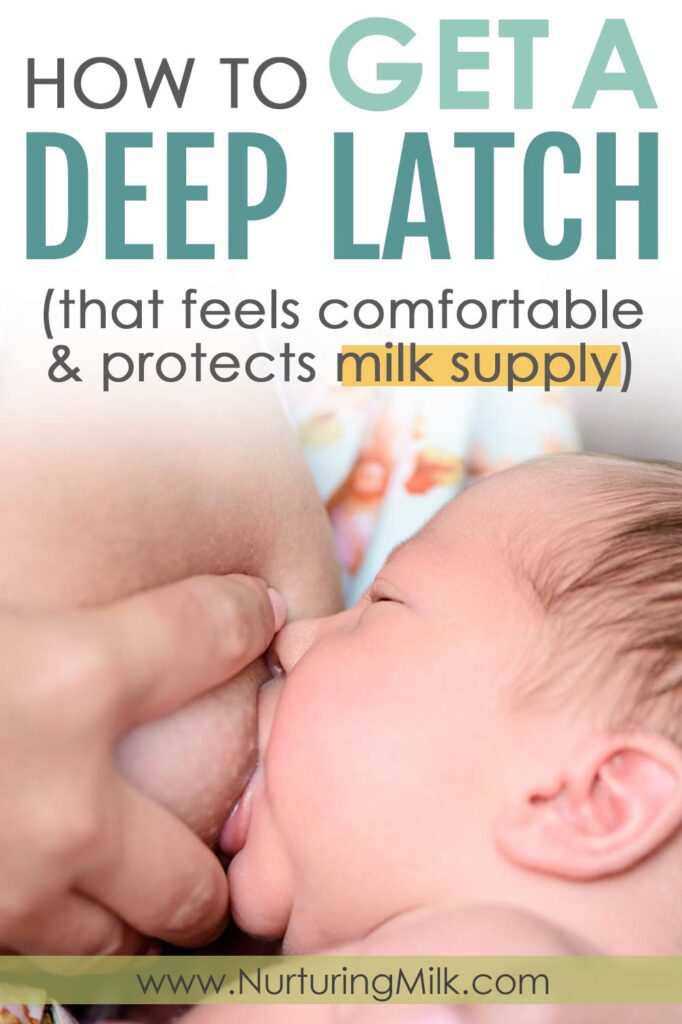
A good latch means that the baby’s mouth is open wide, and the nipple and a portion of the areola are inside the baby’s mouth.
A shallow latch can cause discomfort and pain for the mother, and the baby may not get enough milk.
To ensure a good latch, make sure the baby’s mouth is wide open, and the nipple is pointing towards the roof of their mouth.
If you are having a difficult time, seek help from lactation consultants in your area.
Learn breastfeeding in under 90 minutes for only $27!

Guide to Breastfeeding Frequency
In the first few weeks after birth, it is essential to breastfeed your baby frequently.
Newborns typically need to feed every 2-3 hours or eight to twelve times in a 24-hour period. Some babies may need to feed more frequently, and others may need to feed less often.
In reality, you will be spending most of your day (and night) nursing your newborn in the first few weeks and months.
Thus, you will find yourself attending more to your baby than anything else which is why having a support system, (your husband and family) is crucial.
Also, there are babies who feed literally 2-3 hours all day and all night. At least my youngest did as compared to my eldest who slept all night so it was truly an adjustment the second time around.
The trick is to rest and sleep as much as with your baby.
Let’s make it visual. Shall we?

It is important to pay attention to your baby’s hunger cues!
It’s no guessing game with a baby as long as you look out for the cues.
Signs that your baby is hungry include rooting, sucking on their hands or fingers, and making smacking or lip-smacking sounds.
Crying is a late hunger cue, and it is best to offer the breast before the baby becomes too upset.
Down below is an infographic for the baby’s hunger cues. You may download it for reference.

Breast Milk Production
Breast milk production works on a supply-and-demand basis.
Rule of thumb: The more your baby feeds, the more milk your body will produce.
I’d like that emphasized as many moms get it wrong all the time. This is important to note especially if you have family members who tell you that it’s better to mix feed with formula while also breastfeeding.
I see mothers struggling with this. They give up breastfeeding easily just because they were told that they aren’t making enough milk and that the baby isn’t getting full.
They do not know that the more you give a bottle instead of offering the breasts, the more you tell your body to produce less.
It is essential to allow your baby to feed on demand and avoid restricting feeding times.
If your baby is not feeding frequently enough, it can lead to a decrease in milk production.
It is that simple!
That is why it is also important to take care of yourself by staying hydrated and eating a healthy, balanced diet.
I have written here a helpful post for the best drinks to consume for a breastfeeding mom.
Drinking plenty of water and eating foods high in protein and healthy fats can help support milk production.
One really good tip that I can give you that helped improved my breast milk supply is taking supplements and consuming lactation cookies and smoothies!
They are not only helpful but also very delicious! Buy yourself these treats!
Breastfeeding Challenges
Breastfeeding can be challenging at times, especially in the early weeks.
Common challenges include sore nipples, engorgement, and clogged milk ducts – all of these I’ve experienced myself.
If you experience any pain or discomfort while breastfeeding, it is essential to seek help from a lactation consultant or healthcare provider.
It is a fact that in some cases, breastfeeding may not be possible or may not be the best option for you and your baby.
Formula feeding is a safe and healthy alternative to breastfeeding, and it is important to remember that every mother and baby’s situation is unique.
Breastfeeding Benefits
Breast milk is the perfect food for your baby, providing all the necessary nutrients for growth and development.
It contains antibodies that help protect your baby against infections and illnesses, as well as hormones and enzymes that support your baby’s digestive system.
Breastfeeding also provides numerous health benefits for the mother, including reducing the risk of breast and ovarian cancer and promoting faster postpartum weight loss.
It also releases hormones that promote bonding and attachment between the mother and baby.
Read here for a full article on the benefits of breastfeeding for mom and baby.
Breastfeeding in Public
Breastfeeding in public is a natural and legal right in many countries. It is important to feel comfortable and confident breastfeeding your baby wherever you may be, whether it’s in a park or a shopping mall.
As for me, my rule is that whatever makes you feel comfortable for you and your baby is what matters most.
If you feel uncomfortable breastfeeding in public, you can use a nursing cover or find a private area to breastfeed.
This is what works for me. I look for breastfeeding stations in malls, hospitals, and other public places. I make sure that I plan ahead whenever we needed to go out with my baby in tow.
However, it is essential to remember that breastfeeding is a natural and beautiful act, and you should never feel ashamed or embarrassed to breastfeed in public.
Breastfeeding and pumping at work
Returning to work while breastfeeding can be a challenging experience. As much as you want to stay with your precious little one, maternity leave is ending!
I know, right? Ugh! I struggled with this with my first baby because of one, separation anxiety, and two, I had no idea how I am going to continue providing breast milk for her while I’m working.
Gladly, it is possible to continue breastfeeding while working outside the home. Many workplaces offer facilities for pumping breast milk, and there are several options for storing and transporting breast milk, including refrigeration and freezer bags.
How to Manage Pumping at Work
It is important to communicate with your employer and co-workers about your breastfeeding needs and to develop a plan that works for both you and your workplace.
In my experience, I am happy that my boss and officemates were very supportive. There are even times when they remind me of my pumping session if I happen to forget the time passing and am so focused at work.
They provided a place for me to pump which is an empty classroom next to our office. I made sure that they are informed of my pumping schedule and they lovingly give me privacy.
I would bring my own cooler bag to where I store my breastmilk. It was a decision for me to not store it in the office refrigerator since my home is a few blocks away and I go home to store the pumped milk at home in the morning by lunch and the afternoon stash after work hours.
My breast pump and paraphernalia are washed every time. Never take cleanliness (and hygiene) for granted to keep breast milk away from any bacteria.
It was a really convenient arrangement for me. I could also directly breastfeed my baby at lunch!
If you want to be fully guided and become successful exclusively breastfeeding and pumping mom while at work, I highly recommended that you enroll at Milkology.

Final Thoughts
Breastfeeding is a natural and beneficial way to feed your baby.
Remember to find a comfortable position, ensure a good latch, feed frequently, and take care of yourself. If you experience any challenges or difficulties, seek help from a lactation consultant or healthcare provider.
It is also important to remember that every breastfeeding journey is unique, and there is no one-size-fits-all approach to breastfeeding. Some mothers may experience challenges or difficulties, while others may have a smooth and easy experience. Be patient and kind to yourself and your baby.
Breastfeeding can also be a wonderful way to bond with your baby and promote their overall health and well-being. It is a special time for both you and your baby, and it is important to enjoy the experience and cherish the moments you spend together.
With the right support and knowledge, you can feel confident and comfortable in your breastfeeding journey.
If you find this post helpful, don’t forget to PIN ME!